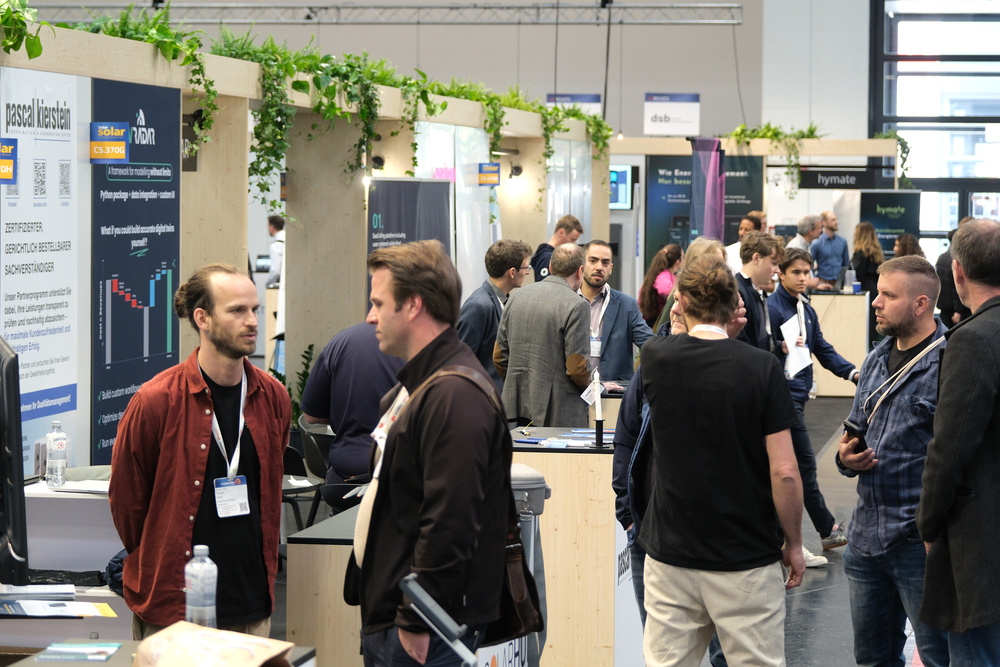
Rising fossil fuel prices are squeezing both businesses and private households. At the same time, the energy transition is creating new opportunities to reduce costs. To fully capture this potential, innovative and tailored solutions are required. With smart energy planning, AI-supported load management, and new business models, startups are helping companies and end users reduce electricity costs and monetize flexibility. Their range of ideas will be on display at EM-Power Europe – The international exhibition for energy management and integrated energy solutions, taking place from June 23–25 at Messe München. In the Start-up Area in hall C4, around 170 young companies will present products and services for an efficient and cost-effective renewable energy supply. EM-Power Europe is part of The smarter E Europe, Europe’s largest alliance of exhibitions for the energy industry. Over three days, around 2,800 exhibitors will be on display, with organizers expecting more than 100,000 visitors.
Electricity from wind and solar is often cheaper to produce than power from gas or coal. Yet output fluctuates depending on weather, time of day and season. In the summer months in particular, power exchange prices fluctuate sharply within a single day. For consumers, the implication is clear: Those able to adjust their energy demand in line with electricity prices and grid charges can cut costs and unlock new revenue streams. Start-up companies are helping to exploit this potential with innovative solutions. Five young companies at EM-Power Europe illustrate the breadth of approaches.
Sound planning is a prerequisite for flexible energy use. Volterica GmbH, a start-up based in Wuppertal, has developed a cloud-based planning and simulation tool that functions as a what-if machine, improving investment certainty and helping to avoid investment mistakes. The tool runs through various scenarios, evaluates investments in energy projects quickly and competently, models complex industrial facilities in detail, optimizes self-consumption and caps peak loads. “We offer an all-in-one software for energy planning,” says Volterica’s founder and CEO Jan-Eric Wörheide. The software is aimed particularly at companies with 50 to 500 employees, as well as planners and developers. Component manufacturers can also use it to simulate heating and cooling units within customer systems.
Saving costs through load management
Cleverwatt GmbH, a Munich-based startup, has built a platform for industry and commerce that combines key levers for reducing energy costs, from the flexibilization of heating and cooling processes to charging infrastructure, on-site electricity generation and storage. Mid-sized companies in food processing, metal finishing and logistics, with annual electricity consumption above 500 megawatt hours, can use the platform to manage daily operations and installations. “We offer holistic potential analyses, optimize procurement strategy and implement AI-based load management,” explains Alexander Heisele, one of the company’s founders. This enables companies to cap peak loads, increase self-consumption from photovoltaic systems, reduce grid charges and trade flexibility on energy markets, saving 15 to 30 percent in energy costs.
The generation of process heat is a major cost driver in industry. Celsio GmbH seeks to shift heat generation to periods of low electricity prices in order to cut costs. The Munich-based startup uses an AI-based algorithm to exploit price volatility in electricity markets, reducing costs in heat-intensive sectors such as chemicals, paper, and food manufacturing. Celsio positions itself as an electricity supplier for cost-efficient and sustainable process heat. Through hybrid operation – combining existing heating systems with electric heat generation – or via heat storage, heat generation can be made flexible by being shifted in time. “By developing the software and using hardware from partners, we can offer our customers a complete solution,” says co-founder Tim Engelmann.
AI-driven energy management system
Sites with high electric loads are the focus of Dutch startup Zympler. The young company offers an AI-driven energy management system (EMS) that proactively monitors and controls energy flows in real time. “The system helps operators stay within their grid’s boundaries, reduce energy costs and control flexible assets intelligently,” says Tom Selten, co-founder of Zympler. The platform goes beyond monitoring, acting as a Digital Chief Energy Officer. It gives businesses total control over PV inverters, storage systems and charging points. Zympler is hardware-independent – a key advantage in environments that frequently integrate systems from multiple suppliers.
Leveraging flexibility in multi-family dwellings
It is not just industry and commerce that stand to benefit from flexible electricity use. New business models are also gaining ground in the building sector. Swiss startup Zevvy has developed an online platform for service providers, real estate companies, utilities and solar installers, particularly in Switzerland and Germany. It supports billing for heating, solar power, e-mobility and water, and can integrate tenant power. “As we do not have our own hardware and are hardware-independent, virtually any system can be connected, allowing our platform to be seamlessly integrated into existing systems and processes,” says Andreas Rüegger, Head of Business Development at Zevvy. Automation and intelligent billing logic can reduce administrative effort by up to 40 percent.
Startups get a stage at The smarter E Europe
The breadth of innovation is also reflected in the presentation program on the Start-up Stage in hall C4. Divided into sessions, young companies will present solutions throughout the three days of the exhibition. On the first day, June 23, start-up companies will focus on reducing energy costs in industry and commerce through artificial intelligence, digital twins and advanced forecasting. Other sessions include Grid Connection, Infrastructure, and Compliance, as well as Prosumers, Flexibility and Energy Communities.