A plug-and-play transformer station at the outdoor exhibition area of Messe München, a cabinet-sized energy system for residential buildings and numerous AI-based services: EM-Power Europe 2026 demonstrated that the energy transition is no longer a question of technological feasibility. The industry’s focus has shifted toward making the transition faster, simpler and more affordable.
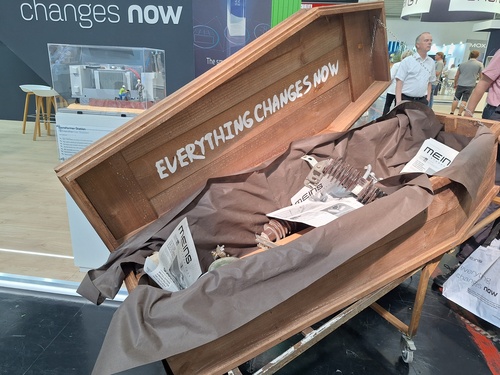
A coffin made its way through the halls of EM-Power Europe 2026 in Munich, carrying the remains of an old analog substation – a relic of a bygone era when electricity still flowed in one direction, from large, centralized power plants to consumers. At the Munich exhibition grounds, exhibitors presented the next generation of technologies for a fully renewable, decentralized energy system. These technologies not only intelligently connect power generation, distribution, storage and consumption. Against the backdrop of tight budgets, a shortage of skilled workers and mounting pressure to expand and modernize grids, the industry is shifting its focus on products and services that can make the transition faster, easier and more cost-effective.
The exhibition also made clear that the perspective on the energy transition has changed. The system is no longer about individual components but about how they interact within integrated, comprehensive solutions – often covering the entire process from planning to installation. While just a few years ago different sectors of the industry were sometimes still competing with one another, for example over whether battery storage, demand-side flexibility or grid expansion alone could manage the complexity of renewable energy systems, a new consensus has emerged: The energy transition’s success depends on cross-sector collaboration.
Standardized expansion of power grids
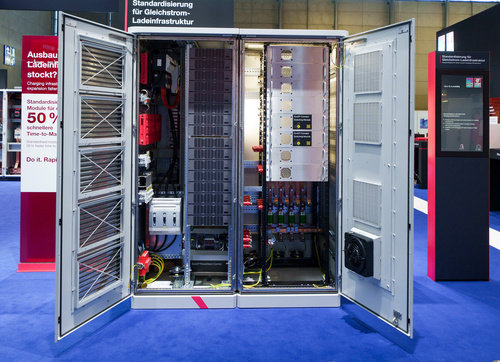
“The entire industry is designed for collaboration,” says Jan Oliver Kammesheidt, Vertical Market Manager Energy at solutions provider Eplan, which exhibited at EM-Power Europe alongside sister company Rittal. The two companies complement each other, with Rittal supplying hardware such as control and protection cabinets and power distribution equipment, while Eplan’s software covers the engineering and planning side. Kammesheidt says the companies place particular emphasis on seamless data flows and extensive collaboration with partners. Their goal is to accelerate the development of high-performance energy infrastructure through standardization and close integration between software and systems engineering.
One example are the control and protection cabinets for transformer stations and electrical substations that Rittal developed in collaboration with automation company Trips. Digital twins of the cabinets are available in Eplan to serve as a template for future infrastructure projects. This approach ensures high data quality, speed and standardization from the engineering phase onward.
The Powerblock, which was also presented at the exhibition, results from a partnership between Rittal and EcoG. The scalable DC power supply system, including charge management for charging parks, electric truck depots and fleet locations, can be expanded in stages and integrated into existing decentralized energy systems. The Powerblock is also available as a digital project in Eplan.
Intelligently connecting sectors
Overcoming sector boundaries by linking power and heat generation, storage and e-mobility as part of holistic energy concepts was the focus of Phoenix Contact’s exhibition presentation. A model of the company’s new headquarters in Blomberg illustrated this approach. The building integrates ice storage and heat pumps, a PV system, battery storage and charging infrastructure. In addition, a DC grid supplies the machines installed on site, allowing renewable electricity to be used directly without conversion losses.
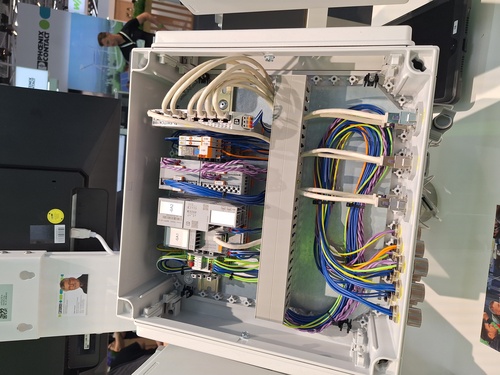
The modernization and digitalization of distribution systems are also essential to the energy transition. “The expansion of electromobility among consumers alone presents a major challenge for grids,” emphasizes Dieter Schrenk, Business Development Manager Solution Sales Energy. A single EV charger can place as much strain on the grid as several households without charging capabilities combined. To improve grid monitoring and control, secondary substations are in urgent need of modernization. Phoenix Contact addresses this need with a modular system whose components can be installed as needed. After all, not every substation requires the full range of equipment. The system includes a control unit, remote control and protection technology and an emergency power supply. The installation of these fully wired modules does not require a specialist and can be configured remotely, Schrenk explains. Simple installation and remote troubleshooting save both time and labor.
Turnkey connection to the high-voltage grid
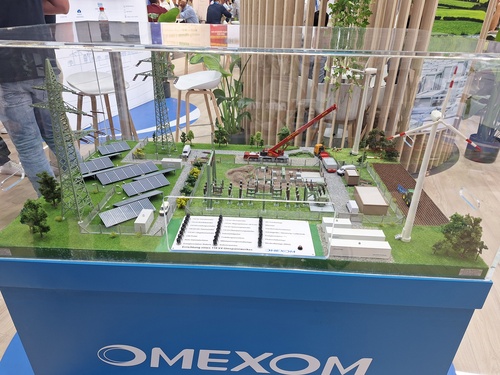
Omexom supplies complete turnkey transformer stations. At EM-Power Europe, the company, which is part of the French Vinci Group, presented a model of such a facility. According to Omexom, demand from large industrial companies looking to electrify their processes is rising. As these companies replace natural gas with electricity, their power demand often rises so sharply that a connection to the high-voltage grid and a dedicated transformer station become necessary.
According to the company, another issue currently affecting the industry is the ban on SF6 gas as an insulating medium in new medium-voltage switchgear up to and including 24 kV. The ban has been in force since the beginning of the year and will be extended to additional medium- and high-voltage switchgear in 2028 and 2030.
Transformer station to go
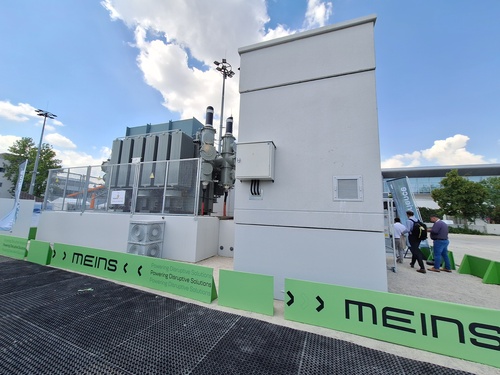
The Spanish company Meins did not settle for presenting just a model as an exhibit. Instead, they arrived with heavy equipment: Outside the Munich exhibition grounds, the Spanish team installed a complete substation demonstrating their innovation’s benefits. According to Meins, the substation has an 80–90 percent smaller footprint than conventional systems. Thanks to its plug-and-play concept, installation and commissioning only takes 14 days.
The modular station comprises high- and medium-voltage switchgear housed in prefabricated concrete buildings. The power transformer is installed outdoors on a custom prefabricated foundation. The compact system, known as CSET, is suitable for generation and consumption facilities up to 50 MVA and grid connections of up to 138 kV. Applications include solar parks, data centers, charging infrastructure and urban power grids, where a small footprint and fast, cost-efficient implementation are required. For this solution, Meins received The smarter E AWARD in the Smart Integrated Energy category.
Using artificial intelligence to combat project backlogs
However, even the best grid connection technology is of little use if projects have already stalled long before reaching that stage. conductr aims to address this challenge with its AI-powered B2B platform designed to bring together project developers, installers, planners, experts and grid operators within a single digital workflow.
“Anyone who wants to implement a project, such as building a solar farm, can enter their requirements on our platform and receive support every step of the way: from site evaluation to grid connection,” explains Gratian Permien, the start-up’s founder and CEO. To achieve this, the company has so far integrated around 60 modules into its software which map each project step and are provided by partners such as certification bodies, planning firms, consultants and technical equipment suppliers. This approach is intended to implement projects faster and avoid costly delays. The service is aimed at project developers, planners and installers of commercial systems.
For many companies, the challenge lies not only in developing energy projects but also in financing them and making them economically viable. This is where Wattstor comes in. Originally from the United Kingdom, the utility company entered the German market in early 2025, offering a comprehensive energy supply solution to small and medium-sized industrial and commercial companies. The company offers hands-on services for the planning, financing, construction and operation of energy infrastructure, combining photovoltaics, battery storage and smart energy management.
The model is built around a contractually guaranteed price cap that protects companies against extreme volatility in the electricity market while allowing them to benefit from favorable market conditions. “This makes energy costs predictable rather than volatile,” explains Jochen Schneider, Managing Director of Wattstor. “It enables CO₂ savings, 20–30 percent cost reductions and strengthens economic resilience without having to invest and without interfering with the production process.”
The start-up Otter Energy Trading focuses entirely on electricity trading. “Energy trading is still far too complicated for ordinary plant operators to participate in effectively,” says Roman Kurpatov, one of the company's two Managing Directors. Together with his team, he wants to change that. On behalf of commercial customers, Otter markets PV electricity either on the energy exchange or directly to consumers, offering a dynamic electricity tariff, marketing battery storage systems and brokering Power Purchase Agreements (PPAs). Their target groups include the real estate industry, farmers, energy cooperatives and companies with multiple locations.
When it comes to battery storage, the start-up company takes a multi-use approach. Rather than using storage systems exclusively to optimize self-consumption or manage peak loads, a smart algorithm markets available capacity on the day-ahead and intraday markets. This allows storage systems to generate revenue even during periods of low PV generation.
Otter’s Trading as a Service offering also enables participation in professional electricity trading for providers of energy management systems, flexibility marketers and other companies. Through standardized interfaces, these organizations can trade electricity without having to act as energy suppliers themselves. To support this, the start-up provides access to the energy exchange, balancing group management, price forecasts and real-time market data.
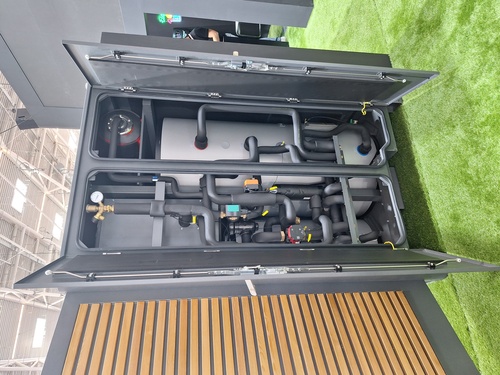
Elephant Power is another young cleantech company from Stuttgart founded in 2025. This year, they presented their own booth at EM-Power Europe for the first time. The aim of the Elephant One system is to simplify and accelerate the energy transition in the building sector. The Elephant is a modular, plug-and-play solution for outdoor use that combines all key components of a renewable energy supply for residential buildings in a single system. These include an 11-kW heat pump, a heating element, a 24-kWh battery, hot water and buffer storage tanks, inverters, the required electrical components and an integrated energy management system. A photovoltaic system can be connected directly.
All equipment fits into a 2.6-sqm cabinet, taking up significantly less space than the elephant that gives the system its name. “Our target group includes heating installers as well as solar specialists,” explains Danijel Sistov, co-founder and COO. “Everything is pre-assembled. Delivery and installation can be done by two installers with a pallet truck. The system can be connected within a day without disturbing residents or causing any loss of comfort. This eliminates the need for a boiler room.”
According to the company, the system is suitable for both new construction and existing buildings. Multiple energy cubes can be combined to meet higher heating demand. Elephant Power is also planning to create an interface with existing Home Energy Management Systems (HEMS) for its partners. This will allow utilities, PV providers and platform operators to integrate their own software solutions.