Germany’s energy transition has entered a new phase with the nationwide rollout of dynamic electricity tariffs and smart meters mandated under recent energy digitisation legislation. By linking electricity prices to real‑time market conditions and equipping consumers with advanced metering infrastructure, these reforms aim to improve flexibility, increase renewable integration, and provide households with opportunities to optimise costs. In reality, however, it is apparent that the provision of dynamic electricity tariffs and smart meters by energy suppliers has not yet been implemented everywhere or designed in a transparent manner. Current market dynamics, challenges, and opportunities will be discussed at the “Energy Transition Awards” ceremony on June 25, 2026, at “The smarter E Europe”, Europe’s largest trade fair alliance for the energy industry, alongside honouring energy suppliers’ outstanding achievements in future-oriented fields.
Bonn, February 12, 2026: Back in 2023, the German Federal Ministry for Economic Affairs and Climate Action presented a draft law to relaunch the digitalisation of the energy transition, aiming to modernise the electricity system and accelerate the nationwide rollout of smart meters. The proposal included provisions to speed up the introduction of dynamic electricity tariffs to make smart-meter usage more financially attractive for consumers. In 2025, the Bundestag reiterated that the smart-meter rollout remains a central pillar of energy transition digitalisation, reflecting ongoing political emphasis on deployment and system integration. This follows the fundamental revision, simplification, and streamlining of the legal framework for smart meters in May 2023, which provided clearer rules and a more robust foundation for nationwide implementation.
Dynamic tariffs are designed to encourage consumers to shift their electricity usage to times of low demand or high renewable generation, helping to balance the grid and reduce overall system costs. Since January 01, 2025, electricity suppliers in Germany are legally required to offer dynamic or variable tariffs to all customers with smart meters dynamic or variable tariffs to all customers with smart meters, supporting households in responding to market price signals and leveraging flexibility options such as heat pumps and electric vehicle charging.
Smart meters form the technical backbone of this shift. Following legislative changes intended to accelerate deployment, the Smart Meter Act sets out a staged rollout through 2032, with binding targets of at least 20% of eligible metering points equipped by the end of 2025, 50% by 2028 and 95% by 2030. Smart meters provide high-resolution consumption data and secure communication channels that enable dynamic pricing, advanced energy management, and integrated monitoring across electricity, heating, gas, and water.
Despite legal mandates and regulatory support, challenges remain. The nationwide rollout has accelerated compared with earlier years, but price limits and cost burdens for optional installations have been adjusted upwards, raising concerns among consumer advocates about affordability and acceptance. Public debate highlights that while many households support smart meter technology in principle, concerns about privacy, cost transparency, and technical complexity could slow broader uptake.
Embedding dynamic tariffs and smart meter capabilities effectively into energy service portfolios is therefore not just a technical task, but also a question of consumer engagement and education. Local municipal utilities (Stadtwerke) play a particularly important role in this context, as they often maintain the closest customer relationships and can build trust through transparent communication, tailored services, and community-based outreach. According to the Verbraucherzentrale Bundesverband, awareness of dynamic pricing and the practical benefits of smart meter services remains limited among many end customers, underscoring the role that energy providers must play in communication, trust‑building, and product innovation.
By expanding its analysis to include dynamic tariffs and smart meter integration, the Energy Transition Award further aligns its methodology with the realities of an evolving energy system. The award, which was jointly initiated by EUPD Research and The smarter E Europe, will be presented for the 10th year in a row in 2026. It aims to recognise energy providers that go beyond compliance by offering forward‑looking services that empower consumers and support the broader energy transition. In addition to a detailed analysis of multiple criteria across relevant future domains in the DACH region, the award highlights utilities from Denmark, France, and Italy for the third consecutive year. Moreover, this year, recognition has expanded to include exemplary energy transition efforts from the Netherlands, Norway, Spain, and the United Kingdom, reflecting a broader commitment to cross-European innovation and sustainability.
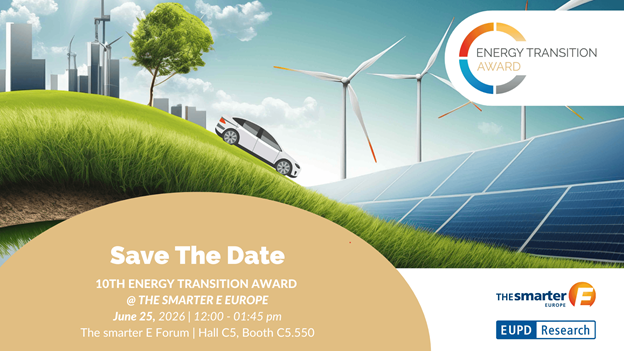
On June 25, 2026, the 10th Energiewende Award ceremony will take place at The smarter E Forum, Hall C5, Booth C5.550 at The smarter E Europe in Munich, Europe’s largest alliance of exhibitions for the energy industry, to celebrate and honour the most innovative energy suppliers who have shown exceptional commitment and progress in promoting the energy transition.
Further information on the Energiewende Award can be found on the website. If you have any questions, please contact Saif Islam (+49 (0) 228 504 36-20, islam[at]energiewende-award.de), Giulia Lohmar (+49 (0) 228 50435-34, g.lohmar[at]eupd-research.com) or Kim Wiersberg (+49 (0) 228 50435-55, k.wiersberg[at]eupd-research.com).
Further information on The smarter E Europe can be found at http://www.thesmartere.de
Press Contacts:
Julia Lünnemann
International Communication and Event Manager
EUPD Group
j.luennemann[at]eupd-research.com
Katja Werner
Corporate Communications Manager
EUPD Group
k.werner[at]eupd-research.com
About the EUPD Group
Since its foundation in 2000, the EUPD Group has been developing innovative, integrated solutions for sustainability-oriented companies. We lead companies to success with our data-based market research and consulting services in the areas of energy, social and ESG. On the one hand, we have specialised in technology sectors such as photovoltaics, energy storage, heat pumps and electromobility under the topic of “Energy”. In the “Social” category, we also offer services in areas such as occupational health management and equal opportunities, while “ESG” focuses on corporate sustainability and responsibility issues, including their transparency in reporting. Our aim is to help companies become and remain competitive, create optimal framework conditions and develop business opportunities.