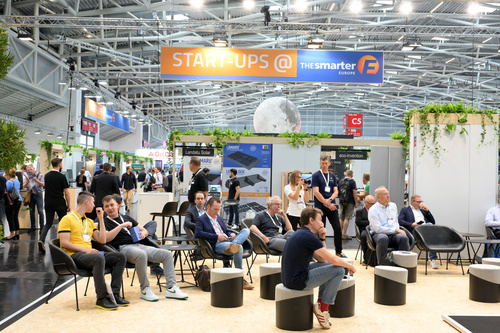
Both companies and consumers are feeling the strain of high energy prices — but the energy transition has the potential to significantly reduce these costs. Innovative start-ups are helping companies tap into this potential. With smart energy planning, AI-supported load management and new business models, they help reduce costs and strategically market flexibility. With examples from five start-ups, we will show you how different the approaches can be. You can find more innovative ideas in the Start-up Area at EM-Power Europe from June 23–25, 2026.
Electricity markets are becoming increasingly volatile, which presents an opportunity for companies and end users alike. Due to the expansion of renewable energies, electricity prices on spot markets often fluctuate significantly throughout the day – especially during summer when a lot of solar power is fed into the grid. For consumers, this means that if you can align your energy demand with these dynamics, you can reduce costs and generate additional revenue. The possibilities range from maximizing self-consumption of PV electricity and optimizing grid charges through storage marketing to variable electricity consumption based on spot market prices and supplying operating reserves.
As every installation and generation process is different, in practice, most need an individual solution. Start-ups support their customers with innovative products and services that optimally control energy flows so that they can concentrate on their main business. From May 23–25, 2026, at EM-Power Europe in Munich, young companies will showcase their solutions, demonstrating the wide variety of approaches.
Before flexibility can be utilized, you need a solid basis for planning. This is where Volterica, a Wuppertal-based start-up, and its planning and simulation tool come in. “We offer an all-in-one software for energy planning,” explains Volterica’s founder and CEO Jan-Eric Wörheide. Companies can quickly simulate different scenarios and investments and evaluate them in depth, such as the best battery design to cap peak loads or optimize self-consumption. It can also model complex industrial plants in their entirety, including all relevant assets, energy carriers and material streams.
The software is primarily aimed at medium-sized companies with around 50–500 employees, as well as planners and project developers, replacing many traditional approaches based on Excel. Another target audience of the software is component manufacturers, who can use it to simulate their heating and cooling systems in their customers’ environments, for example. The intuitive tool is offered as Software-as-a-Service and provides transparent calculations. “We enable fast and solid energy planning – even for companies where planning has not been part of the core business,” says Wörheide.
While Volterica addresses planning, Cleverwatt concentrates on the operation and control of systems at medium-sized companies. Founded in Munich in 2024 as an energy consulting company, the start-up now mainly provides proprietary software solutions. “We offer holistic potential analyses, optimize procurement strategy and implement AI-based load management,” explains Alexander Heisele, one of the company’s founders. Important levers include the flexibilization of heating and cooling processes, charging infrastructure, self-generation (especially PV electricity) and storage. At present, the greatest savings potential comes from reducing grid charges, followed by increased self-consumption and the ability to respond to spot market prices, allowing customers to reduce energy costs by 15–35%.
The start-up focuses on companies with an annual electricity consumption of around 500 megawatt hours, such as those in food processing, metal finishing and logistics. Cleverwatt also markets its software tools to solar specialists, who can use them for consulting. Because regulatory and customer operational requirements are constantly changing, the start-up aims to provide companies with long-term support.
Generating process heat is a large cost factor in industry. Celsio aims to reduce costs by shifting heat generation to times of low electricity prices. The start-up, founded in Munich at the start of 2025, is an electricity supplier for sustainable and cost-efficient process heat. Customers include companies from the chemical, paper and food processing industries, where energy consumption is primarily driven by process heat generation, such as steam production.
Flexible heat generation can be achieved through hybrid operation with existing plants or by using heat storage systems. To optimize electricity consumption, Celsio uses proprietary models that also include forecasts and participates in various electricity markets, from day-ahead and intraday to operating reserve. “By developing the software and using hardware from partners, we can offer our customers a complete solution,” says co-founder Tim Engelmann. The contracts are tailored to each customer’s needs. Models similar to energy savings performance contracts, in which Celsio receives a share of the achieved savings, are also possible.
Zympler’s solution is geared toward locations with high electric loads resulting from charging infrastructure, battery storage or PV systems. At a time when high-performance grid connections are often scarce and electricity prices are increasingly volatile, the Dutch start-up’s energy management system (EMS) helps control energy flows. It primarily focuses on charging infrastructure, depot charging and logistics applications, reflecting the company’s origins. The founders already had experience with electromobility and energy management systems.
“The system helps operators stay within their grid’s limits, reduce energy costs and control flexible assets intelligently,” says Tom Selten, co-founder of Zympler. The business model is based on Software-as-a-Service. Customers pay to use the EMS, typically per location, asset or module. The system is not just a monitoring tool. It can also control installations such as storage systems, charging points and PV inverters. Zympler is not tied to specific hardware – a key advantage, as systems from different suppliers are often combined.
It is not just industry and commerce that stand to benefit from flexible energy use. New business models are also emerging in the building sector, as illustrated by Swiss start-up Zevvy and its intelligent online platform. It helps service providers bill for the joint supply for buildings, including for heating, solar power, e-mobility and water. Tenant power can also be integrated. The target group includes service providers, real estate companies, utilities and solar companies, mainly in Switzerland and Germany.
Zevvy is an open platform that is used as a white-label solution by service providers, such as metering providers, who want to offer a complete package. “As we do not have our own hardware and are hardware-independent, virtually any system can be connected, allowing our platform to be seamlessly integrated into existing systems and processes,” says Andreas Rüegger, Head of Business Development at Zevvy. Automatization and intelligent calculation logic significantly reduce the time and effort required for repetitive administrative tasks, at times by more than 40 percent.
These examples highlight the growing economic importance of industrial flexibility. Businesses that proactively manage their energy flows not only reduce costs, they also generate additional revenue. What’s more, they benefit the overall system. As the share of renewables grows, the ability to flexibly balance supply and demand is becoming increasingly important. Flexibility is thus emerging as the new currency in the energy system, as well as a competitive factor for businesses that make use of it.